
Case study · Personal project

Family Move Planner: one place to plan our move

There were too many variables to keep track of, so I built a one-stop shop where my wife and I can see homes, rates, towns and daycares at a glance. We're busy parents, and I wanted to make at least one part of this move a little easier and more organized.

RoleDesign & development
StartedSeptember 2026
Built withCloudflare Workers, D1, R2
Creative partnerClaude Code
Real app · sample data
A listing card from the Family Move Planner, with sample data: 14 Orchard Rd, fit score 89, 12 minutes to the in-laws, $3,764 a month, a $25,000 price cut, and payments at 6, 5 and 4 percent.

Every home gets the same card, so comparing them takes seconds. (Sample listings; house photos from Pexels.)

  1. Fit scoreOne score per home, built from the payment, size, bedrooms, baths, schools and drive time.
  2. Drive to the in-lawsReal drive time for every home.
  3. Monthly paymentAll in, and the biggest number on the card. Green if it fits our budget, red if it doesn't.
  4. Weekly rate changeWhat this week's rate did to this home's payment. Click it for the history.
  5. Price trackingEvery price change, tracked week to week.
  6. Rate what-ifsThe same home at 6, 5 and 4%.

Why I built it

Homes, mortgage rates, towns, daycares. There were too many variables to keep track of. I wanted one organized planner and tracker that my wife and I could both open and understand at a glance.

Every listing site leads with the sticker price, but the number that actually decides things for us is the monthly payment. So that's the biggest number on every card.

How we've used it so far

The town research has helped the most so far. We started with a bunch of towns in mind, and after the research in the tracker we have a much clearer picture of which ones make the most sense for us.

As we get closer to moving and choosing a home, the rate tracker and the home feed are going to be the parts we lean on the most.
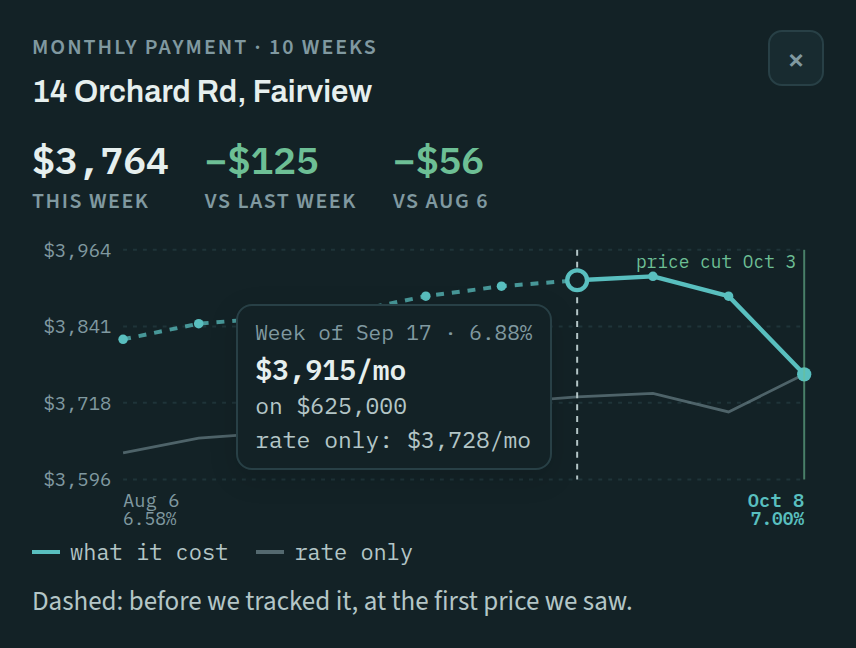
Real app · sample data Weekly payment history for one home: ten weeks of monthly payments, a price cut on October 3, and a tooltip showing the payment for the week of September 17.

The weekly history for one home. It tracks the price and the rate every week, so you can see what a price cut or a rate jump actually did to the payment.

What I'm proudest of

  • Leading with the monthly payment. It's the number that tells us whether a house is realistic.
  • Pulling listings from multiple sources and narrowing them down to our criteria, so we only look at homes worth our time.
  • The daycare research, in the same place as the towns and homes.

What I learned

How important the mockup and design phase is before building anything. Making changes to live code is a lot more expensive and time-consuming than changing a mockup.

Now every new feature starts as a few quick mockups, and I pick one before anything gets built.